
Shopee, Lazada & Shopify Migration in Singapore
We move Singapore sellers off marketplace dependence and onto a store they actually own.
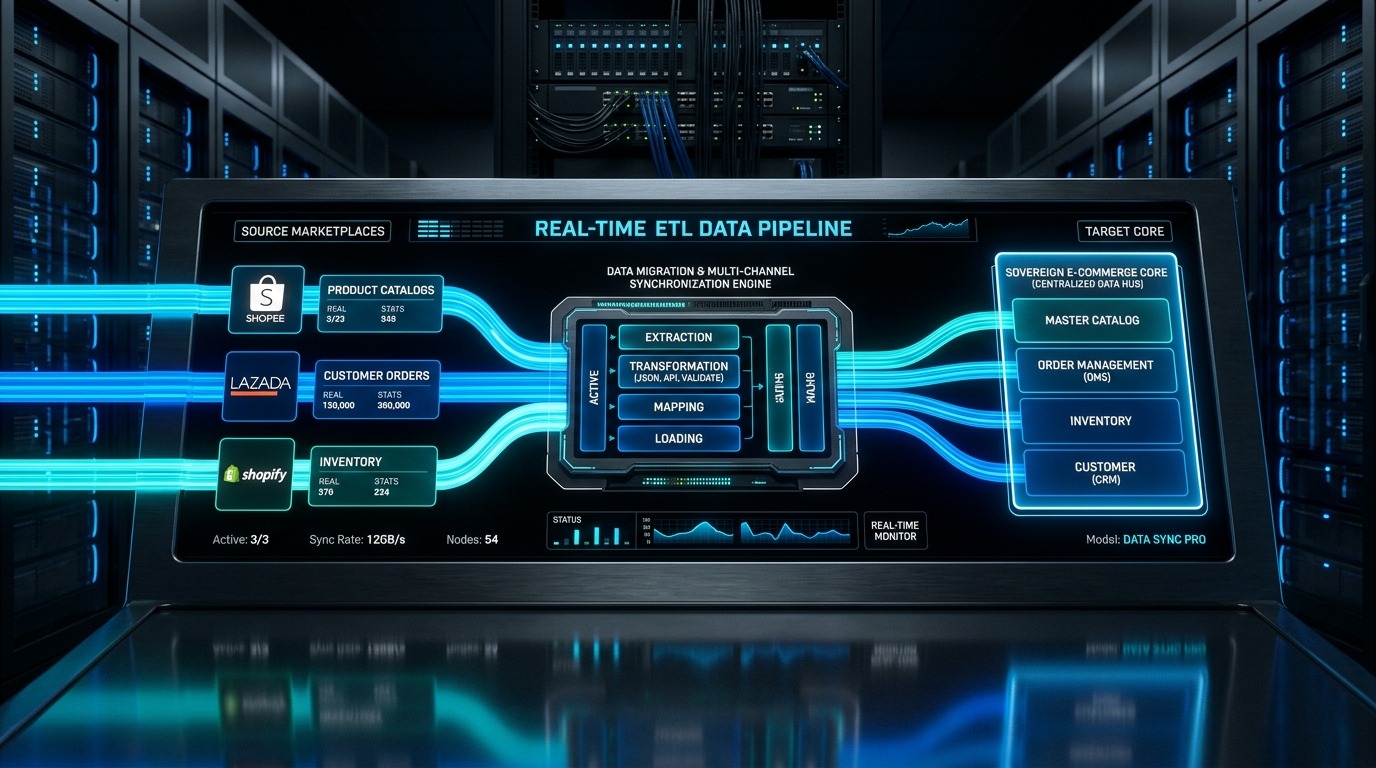
Marketplace Migration Pipeline: Real-time multi-channel data extraction, schema normalization, and automated catalog synchronization into an independent brand store.
The brief
Who it’s for
For Singapore and Malaysia sellers who have built real revenue on Shopee or Lazada but are tired of 5–15% commissions, forced discounts, and never seeing who their customers are. Also for merchants outgrowing a DIY store, or moving between platforms (WooCommerce to Shopify, Shopify to Medusa) without losing catalogue integrity or SEO.
Your products, variants, images, stock levels and category structure are migrated from Shopee, Lazada, TikTok Shop, Amazon or an existing platform into Shopify, WooCommerce or a custom store — cleaned up on the way, not just dumped across. You keep selling on the marketplaces if you want to; the difference is you finally own the customer, the data and the margin.
Example engagement · for illustration
Move a store without losing track of orders or URLs.
A store has outgrown its platform. Products, customer permissions, historic orders and search landing pages need different migration decisions; a bulk export alone does not cover the move.
A practical sequence
- 01
Inventory data, integrations and important existing URLs.
- 02
Rehearse the agreed migration on a separate copy and reconcile records.
- 03
Plan the cutover window, redirects, final order sync and rollback.
An example of how the work could be scoped, not a client result. Your proposal sets the deliverables and acceptance criteria.
Agree before work starts
What completion looks like
- Check 1
Sampled variants, prices and stock agree with the approved source at cutover.
- Check 2
Priority old links reach equivalent destinations, and new orders follow the tested fulfilment path.
Scope boundary
Historic passwords or platform-specific features may not transfer. Customer communications and any re-consent need their own agreed plan.
6 parts
What’s included
Full catalogue migration
Products, SKUs, variant matrices, pricing, stock, weights and category structure moved across and reconciled — not a lossy CSV dump.
Images & media transfer
Every product image and gallery downloaded from the marketplace, renamed, compressed and re-hosted on your own store so nothing hotlinks back.
Data clean-up & enrichment
Duplicate SKUs merged, marketplace clutter stripped from titles, descriptions rewritten for search, and missing attributes filled in.
Customers & order history
Where the platform permits export, we bring across customer records and past orders so your new store starts with history, not an empty database.
SEO-safe launch
Clean URL structure, redirects from any existing site, schema markup and a sitemap — so you launch without losing the rankings you already have.
Keep selling everywhere
Optional inventory and price sync so your own store and your marketplace listings stay aligned instead of drifting apart.
Outcomes
What it changes
- Stop paying 5–15% marketplace commission on every order you could have owned
- Own your customer list, email and remarketing — the asset a marketplace never gives you
- Set your own prices and promotions instead of being pushed into platform-wide discounts
- Build a brand customers return to directly, rather than a listing they scroll past
- Keep marketplace sales running during and after the move — this is not all-or-nothing
Engagement and pricing
How it is sold
Export access, messy product data, URL changes and parallel-running requirements drive migration effort.
A written scope identifies the deliverables, exclusions, dependencies and any recurring charges before work begins.
What to bring to the first conversation
Source platform, approximate record counts, integrations and a list of essential historical data.
Share a redacted example first. Access to accounts and sensitive records is arranged separately.
Explore the work and the decisions behind it.
Questions about
Store Migration
How do I move my Shopee store to Shopify?
You export your product catalogue from Shopee Seller Centre using the mass-upload template, then map every field — SKUs, variants, prices, stock, images — into Shopify's structure. The hard parts are variant matrices and images, which generic converters usually mangle. We handle the export, the mapping, the image transfer and the launch, and you can keep your Shopee shop running throughout.
Can I migrate my Lazada products to my own website?
Yes. Lazada lets sellers export their catalogue from Seller Centre, and we migrate those products, variants and images into Shopify, WooCommerce or a custom store. Nothing is deleted on Lazada — you decide later whether to keep both channels or wind the marketplace down.
Will I lose my reviews and ratings?
Honestly, yes — marketplace reviews belong to Shopee or Lazada and cannot be transferred to your own store. That is the one thing migration cannot bring across. What we do instead is set up a review system on your new store from day one and help you invite past customers to review you there.
How long does a store migration take?
A typical Singapore SME catalogue of a few hundred products takes about 2 to 4 weeks end to end, including data clean-up, design and testing. Very large or messy catalogues take longer. We give a fixed quote and timeline after a free scoping call.
How much does it cost to migrate an e-commerce store in Singapore?
It depends mostly on catalogue size, variant complexity and how much clean-up the data needs. A straightforward migration onto a standard Shopify or WooCommerce build typically starts in the low thousands; larger or custom builds cost more. New applications moved to EDGE on 30 September 2026. Existing EDG, PSG and MRA submissions and projects continue under their original process. Check the exact activity, applicant conditions, supported costs, provider requirements and timing with Enterprise Singapore before relying on funding. GDI can prepare the technical scope and quotation; approval is the agency's decision.
Can I still sell on Shopee and Lazada after moving?
Yes, and most sellers should at first. The marketplaces keep bringing discovery traffic while your own store builds direct sales. We can set up inventory and price sync so the channels do not drift out of step.
Is e-commerce migration covered by government grants?
New applications moved to EDGE on 30 September 2026. Existing EDG, PSG and MRA submissions and projects continue under their original process. Check the exact activity, applicant conditions, supported costs, provider requirements and timing with Enterprise Singapore before relying on funding. GDI can prepare the technical scope and quotation; approval is the agency's decision.
Related services
All servicesTell GDI what you need built, fixed or run.
Or WhatsApp +65 8714 1149 · or
A written reply, usually within one business day.