
Self-Hosting a Private AI Model in Singapore: Enterprise Blueprint (2026)
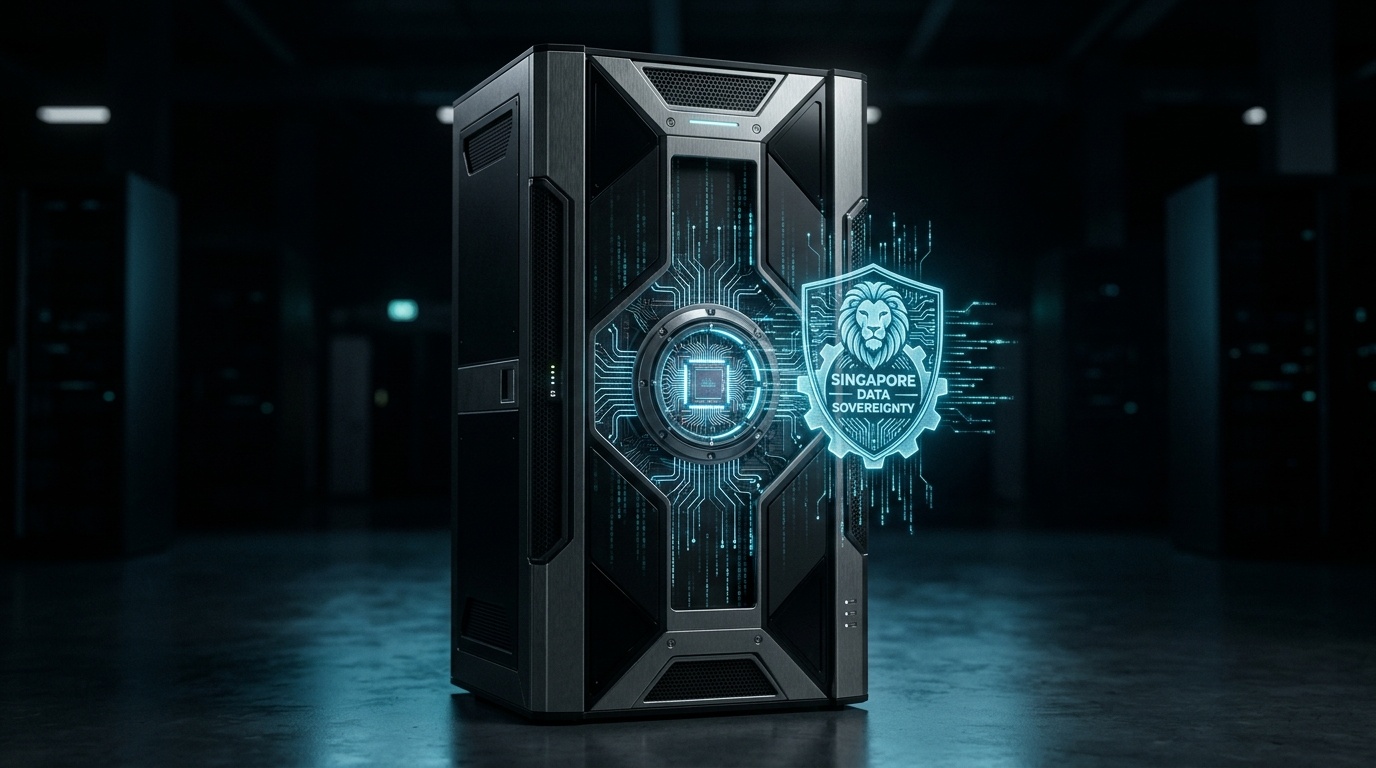
Private Singapore Enterprise AI Architecture: Dedicated inference node running an open-weights model with local network isolation and PII redaction.
For Singapore legal, financial, and healthcare organisations, sending unmasked documents to overseas public AI APIs triggers cross-border transfer considerations under PDPA Section 26. This engineering blueprint outlines how to self-host quantized open-weights reasoning models on private Singapore infrastructure — keeping inference payloads within your network perimeter while trading variable per-token API bills for predictable infrastructure costs.
The Singapore Data Residency Context (PDPA & MAS TRM)
Under Section 26 of Singapore's Personal Data Protection Act 2012 (PDPA) (the Transfer Limitation Obligation, detailed in the PDPC Advisory Guidelines on Key Concepts), organisations must not transfer personal data outside Singapore unless the overseas recipient is bound by legally enforceable obligations providing a standard of protection comparable to the PDPA. Sending unmasked corporate contracts, customer NRIC/FIN identifiers, or financial statements to overseas model endpoints requires appropriate transfer safeguards and data-processing assessments.
For financial institutions and MAS-regulated entities, the MAS Technology Risk Management (TRM) Guidelines set expectations for data confidentiality, cryptographic key management, operational resilience, and third-party service provider oversight. Self-hosting open-weights reasoning models on local Singapore servers (either dedicated on-premises GPU workstations/racks or isolated Singapore cloud VPCs such as AWS ap-southeast-1) keeps prompt payloads and embeddings within your Singapore network boundary.
- In-Country Inference Boundary — Prompt tokens, document embeddings, and model weights remain inside your Singapore server or VPC perimeter.
- Inbound Network Hardening — Private subnets and outbound-only zero-trust tunnels avoid exposing public inference ports to the internet.
- No Third-Party API Training Exposure — Enterprise prompts are processed on weights you control rather than transmitted to external multi-tenant API providers.
Architecture Blueprint: The Private AI Gateway
A production enterprise deployment separates network ingress, data sanitisation, and model execution into three isolated layers:
Requests from internal enterprise tools (CRM, ERP, document management) connect over internal VPNs or zero-trust tunnels to a private gateway. Before reaching the inference engine, every document and prompt passes through a deterministic PII redaction middleware that masks Singapore NRIC/FIN patterns, mobile numbers, and account identifiers.
The model runs on a dedicated inference runtime (such as vLLM or Ollama with published open-weights models) backed by local NVMe storage and dedicated GPU VRAM. The table below summarises typical open-weights model sizes and indicative hardware sizing for 4-bit / FP8 quantized deployment:
| Model Class | Parameter Count | Typical Quantization | Indicative VRAM / Unified Memory | Indicative Hardware Class |
|---|---|---|---|---|
| ~14B distilled reasoning model | ~14B dense | 4-bit (AWQ / GGUF Q4_K_M) | ~12–16 GB VRAM | Single 16GB–24GB GPU workstation |
| ~32B distilled reasoning model | ~32B dense | 4-bit (AWQ / GGUF Q4_K_M) | ~22–24 GB VRAM | Single 24GB GPU or dual 16GB–24GB GPUs |
| ~70B distilled reasoning model | ~70B dense | 4-bit (AWQ / GGUF Q4_K_M) | ~44–48 GB VRAM | Dual 24GB–48GB GPU workstation or cloud GPU instance |
| Full-size mixture-of-experts model | Several hundred billion total (a fraction active per token) | FP8 / INT4 | ~350–700+ GB VRAM | Multi-GPU enterprise cluster node (e.g. 8× H100/H200) |
Production Python Gateway: Streaming Inference with NRIC Masking
Below is a reference FastAPI gateway pattern that handles local streaming inference while applying regex-based Singapore NRIC/FIN masking before the prompt reaches the local model endpoint:
import re
from fastapi import FastAPI, HTTPException
from fastapi.responses import StreamingResponse
import httpx

app = FastAPI(title="GDI Private AI Gateway")

# Singapore NRIC/FIN pattern (S, T, F, G, M followed by 7 digits and checksum letter)
NRIC_PATTERN = re.compile(r"\b[STFGM]\d{7}[A-Z]\b", re.IGNORECASE)
OLLAMA_LOCAL_URL = "http://127.0.0.1:11434/api/generate"

def mask_singapore_pii(text: str) -> str:
    """Mask Singapore NRIC/FIN strings prior to model tokenization."""
    return NRIC_PATTERN.sub("[REDACTED_SG_ID]", text)

@app.post("/v1/reason")
async def execute_reasoning_stream(payload: dict):
    raw_prompt = payload.get("prompt", "")
    if not raw_prompt:
        raise HTTPException(status_code=400, detail="Empty prompt provided")

    # Step 1: Apply in-memory NRIC/FIN redaction
    sanitized_prompt = mask_singapore_pii(raw_prompt)

    # Step 2: Stream tokens from the local reasoning model
    async def token_generator():
        client_timeout = httpx.Timeout(120.0, connect=5.0)
        async with httpx.AsyncClient(timeout=client_timeout) as client:
            request_body = {
                "model": "your-reasoning-model:32b",
                "prompt": sanitized_prompt,
                "stream": True,
                "options": {"temperature": 0.2, "num_ctx": 16384}
            }
            async with client.stream("POST", OLLAMA_LOCAL_URL, json=request_body) as response:
                async for chunk in response.aiter_bytes():
                    yield chunk

    return StreamingResponse(token_generator(), media_type="application/x-ndjson")
Figure 1: Reference FastAPI inference gateway with pre-inference NRIC/FIN pattern masking.
Worked Cost Comparison: Private Infrastructure vs Metered Cloud APIs
Whether self-hosting is cheaper than a commercial cloud API depends on your sustained monthly token volume and concurrency requirements. Low-volume or bursty workloads are almost always cheaper on a metered API; high-volume, steady daily document workloads can reach break-even when hardware is amortised over a 36-month lifecycle.
To model your own workload parameters (monthly query volume, prompt context length, completion length, and model tier), use our interactive Sovereign AI vs Cloud API Calculator. The table below summarises the structural trade-offs across the three main deployment models:
| Deployment Model | Cost Structure | Best Fit Workload | Data Location | PDPA Section 26 Scope |
|---|---|---|---|---|
| Commercial Cloud API (Metered) | Variable per 1M input/output tokens | Low-to-moderate volume or elastic burst traffic | Provider cloud regions (often US/EU) | Cross-border transfer safeguards & DPA review required |
| Dedicated Singapore Cloud VPC (GPU Instance) | Fixed hourly/monthly instance + storage | Medium-to-high volume without on-prem server room | Singapore cloud region (e.g. ap-southeast-1) | In-country hosting; cloud shared-responsibility controls apply |
| On-Premises / Colocated GPU Server | Upfront hardware capex + power/colocation | Sustained daily document or agent pipelines | Customer premises or Singapore colocation rack | No external model API egress; local protection & access controls required |
Production Governance & Security Hygiene Checklist
Keeping model weights inside Singapore addresses cross-border transfer exposure during inference, but a production deployment still requires operational security controls:
- Role-Based Access Control (RBAC) — Restrict who can query the internal gateway and which document collections a retrieval pipeline can access.
- Pre-Inference PII Redaction — Strip or mask NRIC/FIN numbers, bank accounts, and phone numbers before prompts are logged or passed to the model.
- Human-in-the-Loop Review — Require staff sign-off before any model output triggers an external email, customer reply, or database write.
- Audit Logging & Retention — Log prompt metadata and access events with defined retention periods aligned to your organisation's data-protection policy.
Note: This blueprint provides engineering architecture guidance and is not legal advice. Organisations should review their specific data flows with their Data Protection Officer (DPO) or legal counsel.
Frequently asked questions
Does a self-hosted reasoning model run on a standard office workstation?
The distilled models (14B and 32B) run on high-memory workstations equipped with a dedicated GPU (such as an NVIDIA RTX 4080 16GB or RTX 4090 24GB) or a dual-socket enterprise workstation with 64GB+ system RAM. The largest mixture-of-experts (MoE) models require a multi-GPU enterprise server node.
How does local inference latency compare to cloud AI APIs?
Throughput and time-to-first-token (TTFT) depend on quantization level, prompt context length, batch concurrency, and GPU memory bandwidth. Because the inference server runs on your local Singapore LAN or an isolated Singapore cloud VPC (such as AWS ap-southeast-1), requests avoid trans-Pacific network round-trips and third-party public queue throttling.
How does self-hosting relate to the PDPA Transfer Limitation Obligation?
When the model is hosted within Singapore (either on-premises or inside a Singapore-region VPC with no external model API egress), prompt payloads do not leave Singapore during inference, avoiding cross-border personal data transfers under Section 26 of the PDPA. Organisations still remain responsible for all other PDPA obligations, including consent, purpose limitation, access controls, security protection (Section 24), and retention.
Can this setup be integrated with existing Singapore ERP and CRM systems?
Yes. GDI wraps the local inference runtime in industry-standard chat-completion REST endpoints and FastAPI streaming gateways, allowing integration with custom ERPs, InvoiceNow / Peppol document workflows, and internal knowledge bases.
Put this into practice
- AI Automation
AI agents and workflow automation that cut manual work and pay for themselves.
Deploy Private AI Infrastructure for Your Enterprise
We architect, deploy, and harden private AI inference gateways and retrieval pipelines for Singapore businesses, designed to support PDPA data-residency controls and MAS TRM security hygiene.
Consult Our Engineers